



Some road trips end at a crowded park with a picnic table waiting.
Others lead to a quiet stretch of coast with fishing rods in the back and nowhere in particular to be before sunset.
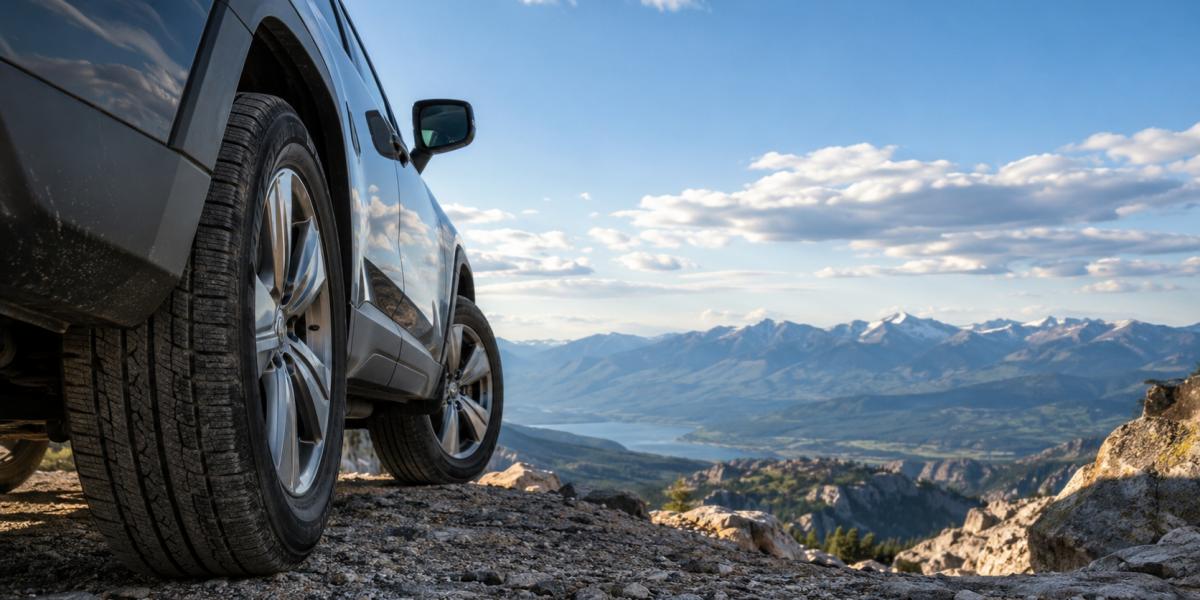
And then there are the roads that keep climbing.
You leave a warm valley in the morning, follow switchbacks into the mountains, and by afternoon you're several thousand feet above where the trip began.
Then you look at the tire-pressure display.
The numbers aren't what you remember.
Maybe they're higher. Maybe they're lower. Maybe the TPMS warning light suddenly appears even though the tires seemed perfectly fine when you left home.

Now comes the confusing part:
Does altitude increase tire pressure or decrease it?
And if the pressure changed, should you add air—or let some out?
The answer isn't simply "higher altitude equals higher tire pressure."
Altitude matters.
Temperature matters.
Driving heat matters.
And sometimes those effects are pulling the pressure reading in opposite directions at the same time.
Does Altitude Affect Tire Pressure?
Yes.
As altitude increases, the atmospheric pressure surrounding the tire decreases.
The Federal Aviation Administration's standard-atmosphere data shows the effect clearly: atmospheric pressure steadily drops as elevation rises. At sea level, standard atmospheric pressure is 29.92 inches of mercury; at 5,000 feet it's about 24.89 inHg, and by 10,000 feet it has fallen to about 20.57 inHg. (Source)

Image source: The Federal Aviation Administration
Why does that matter to a car tire?
Because an ordinary tire-pressure gauge doesn't simply measure the pressure trapped inside the tire in isolation.
It measures gauge pressure—essentially the difference between the pressure inside the tire and the atmospheric pressure outside it.
As the outside pressure falls with elevation, the number shown on a conventional tire gauge tends to rise, assuming tire temperature and other conditions stay the same.
Tire Rack gives a useful practical example: at roughly 5,000 feet, a conventional gauge may read about 2–3 psi higher than it would at sea level at the same temperature. (Source)
So if a tire showed 35 psi near sea level, you might see a somewhat higher gauge reading at elevation without having added a single molecule of air.
That sounds straightforward.
Mountain weather makes it less so.
Why Tire Pressure Can Fall While You're Climbing
Higher altitude tends to push the gauge reading upward.
Colder temperatures push tire pressure the other way.
Michelin notes that mountain driving frequently involves significant temperature changes, and that colder air reduces tire pressure. Its current mountain-driving guidance specifically warns drivers not to focus on altitude alone because the temperature drop encountered while climbing may be more relevant in practice. (Source)
A useful rule of thumb is that tire pressure changes by roughly 1 psi for every 10°F change in temperature. Michelin gives the same approximate relationship in its winter tire-pressure guidance. (Source)
Imagine leaving a valley at 75°F and spending the night at a mountain destination where the temperature falls to 35°F.
That's a 40°F temperature drop.
Temperature alone could pull the tire pressure down by roughly 4 psi.
At the same time, lower atmospheric pressure at elevation tends to make the gauge reading rise.
So two effects are competing:
· Higher altitude → gauge pressure tends to rise
· Lower temperature → tire pressure tends to fall
That's why two drivers making similar mountain trips can report completely different experiences.
One sees a slightly higher PSI.
The other wakes up to a TPMS warning.
Both can be real.
Don't Forget a Third Factor: The Tire Is Hot
This is where drivers often make a mistake.
You climb a mountain road for two hours, stop at an overlook and immediately check the tires.
They read 4 or 5 psi higher than the number on the driver's-door placard.
The natural reaction is:
"I'm at altitude. I need to let some air out."
Not necessarily.
You have also been driving.
Rolling tires flex continuously and generate heat. Warmer air inside the tire increases pressure. Vehicle manufacturers therefore specify recommended tire pressure as a cold pressure, not as the number you should see immediately after a long drive.
NHTSA defines a cold tire as one that hasn't been driven for at least three hours. Its current TireWise guidance recommends checking all tires at least monthly in that condition and using the pressure listed on the vehicle's doorjamb placard or in the owner's manual. (Source)
That leads to one of the most important rules in this entire article:
Don't bleed a hot tire down to the cold-pressure number simply because the PSI increased while you were driving.
If you do, the tire may become underinflated once it cools.
We've covered this same pressure-stabilization issue in Tire Inflator Troubleshooting: Why PSI Changes After Inflation. If you've ever inflated a tire, driven a few miles and wondered why the reading changed again, that guide explains why the number immediately after driving isn't the same as a true cold reading.

Can High Altitude Trigger the TPMS Light?
It can be part of the picture, but a TPMS warning should never be dismissed as "just altitude."
NHTSA explains that the TPMS warning illuminates when the system determines that at least one tire is significantly underinflated. It also notes that the warning may appear on a cold morning and disappear after driving because marginally low pressure can fall below the warning threshold overnight and rise again as the tires warm. (Source)
High-altitude measurement adds another complication.
An Infiniti technical service bulletin filed with NHTSA explains that, on the vehicles covered by that bulletin, a conventional tire-pressure gauge can read higher at altitude than the vehicle's TPMS reading. The bulletin gives an approximate adjustment of 1 psi per 2,200 feet of elevation for a standard gauge, up to 10,000 feet. (Source)
That's manufacturer-specific guidance, not a universal formula for every vehicle.
And that's an important distinction.
Different vehicles may measure and display pressure differently. Some use direct sensors inside the wheels; indirect systems infer pressure changes from wheel speed and other vehicle data.
So if your TPMS comes on in the mountains:
Don't assume the sensor is confused.
Find a safe place to stop and measure the tires.
A cold night, an existing slow leak or a tire that was already borderline low before the trip may be the actual reason the warning appeared.
Should You Let Air Out at High Altitude?
Not simply because the gauge number went up.
This is probably the biggest misconception around high-altitude tire pressure.
Suppose you leave home with correctly inflated tires.
You drive to a mountain destination and your pressure gauge now shows a couple of PSI more.
If the tire is hot from driving, releasing air immediately can leave it underinflated later.

Even if the tire has cooled, your vehicle manufacturer may have specific altitude guidance.
Kia, for example, currently publishes high-altitude tire-pressure instructions for some vehicles that specifically call for additional pressure as elevation increases. A 2026 Kia manual lists an additional 1.5 psi per kilometer above sea level for the vehicle covered by that manual. (Source)
That does not mean every car should receive the Kia adjustment.
It means something more useful:
Your vehicle's owner's manual takes priority over a generic altitude rule found online.
If the manufacturer specifies an altitude adjustment, follow it.
If it does not, use the manufacturer's cold-pressure specification and avoid inventing your own altitude correction.
Should You Add Air at High Altitude?
Again, not automatically.
Add air when an accurate measurement shows that the tire is below the pressure your vehicle manufacturer calls for under those conditions.
This is particularly common after a large temperature drop.
You might have started the day correctly inflated in warm weather and arrived at a much colder mountain destination with lower pressure the following morning.
We recommend checking pressure when mountain conditions are substantially colder than where the trip began.
The practical sequence is simple:
| Situation | What Makes Sense |
|---|---|
| Passing briefly over a mountain pass | Monitor pressure; don't chase every small PSI change |
| Arriving at altitude after a long drive | Don't compare hot pressure directly with cold placard PSI |
| Staying overnight at altitude | Check pressure cold the next morning |
| TPMS warning appears | Stop safely and measure every tire |
| Cold pressure is below vehicle specification | Add air |
| Manufacturer specifically requires altitude compensation | Follow that vehicle's instructions |
| Pressure is genuinely above the manufacturer's specified target | Release air carefully |
| One tire differs substantially from the other three |
Check for a leak or damage |
The key isn't elevation by itself.
It's measured pressure under the right conditions.
What Happens When You Drive Back Down?
The same rules apply in reverse.
As you descend, atmospheric pressure increases.
Temperature may also rise substantially if you're traveling from a high mountain area back into a warm valley.
If you never adjusted the tires during your trip, there may be very little to do beyond checking them again once you're home.
But if you added or released air while staying at elevation, check the tires again after returning to your normal environment.
Tire Rack recommends checking cold pressure after arriving at a substantially different altitude and rechecking again after returning home. (Source)
The important word is:
cold.
Not at the bottom of a long mountain descent.
Not five minutes after pulling off the freeway.
Let the vehicle sit.
Then measure.
What If One Tire Changes More Than the Others?
Altitude and temperature affect all four tires.
A puncture does not.
That's an important diagnostic clue.
If three tires are within a narrow range and one is suddenly several PSI lower, don't blame elevation first.
Look for:
· a nail or screw;
· valve leakage;
· sidewall damage;
· wheel damage;
· recurring pressure loss.
NHTSA advises drivers to inspect tires for cuts, punctures, bulges, cracks and other damage at least monthly and before long trips. (Source)
If you've also noticed pulling or vibration through the steering wheel, our guide Why Is My Steering Wheel Shaking? explains how pressure differences, tire damage, wheel balance and suspension problems produce different symptoms.

A mountain trip may reveal an existing tire problem.
It doesn't necessarily create one.
Mountain Travel Makes Tire Pressure Management More Important
For someone driving a compact commuter car around town, being a few minutes from a service station is normal.
Mountain travel is different.
The road to a fishing spot, campsite or trailhead may put you dozens of miles from the nearest working compressor.
And for pickups, large SUVs, trucks and off-road vehicles, there's another practical issue:
The tires simply contain much more air.
That matters because a small emergency pump that feels adequate for adding 3 psi to a sedan tire can become painfully slow on a high-volume truck tire.
We explored this in Why Most Tire Inflators Fail on Heavy-Duty Tires: maximum PSI gets most of the attention on packaging, but airflow, cooling and duty cycle often matter more when the tire itself is large.

That's exactly the kind of situation where carrying a capable inflator stops being a convenience and becomes useful travel equipment.
Managing Pressure Away From Home With the ETENWOLF Vortex S7

High-altitude driving doesn't always mean adding air.
Sometimes it means doing nothing until the tires cool.
Sometimes cold weather means adding pressure.
And in a vehicle whose manufacturer calls for a specific altitude adjustment, you may need to make that correction deliberately.
What matters is having the ability to measure, add or release air when the measurement actually tells you to.
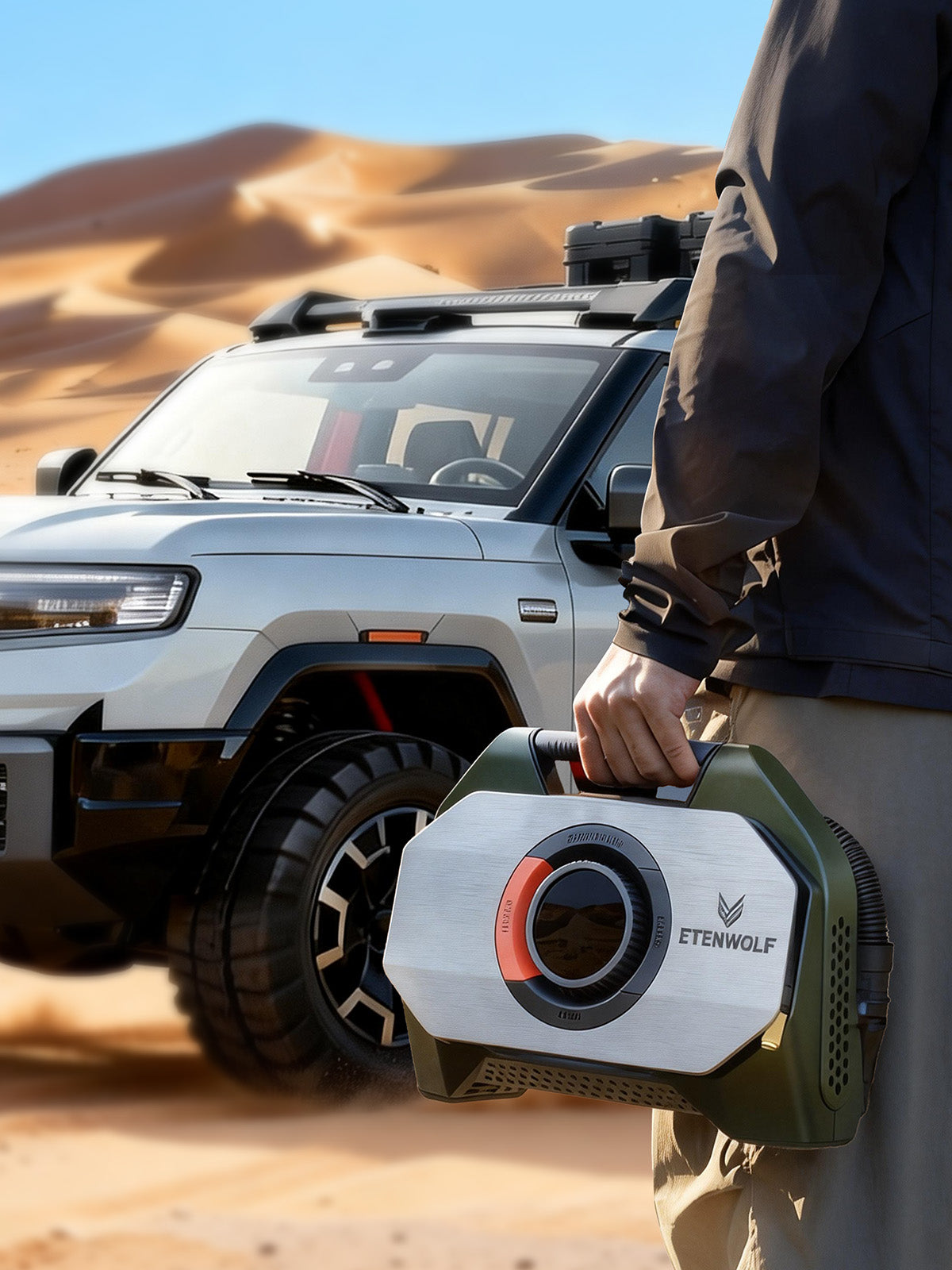
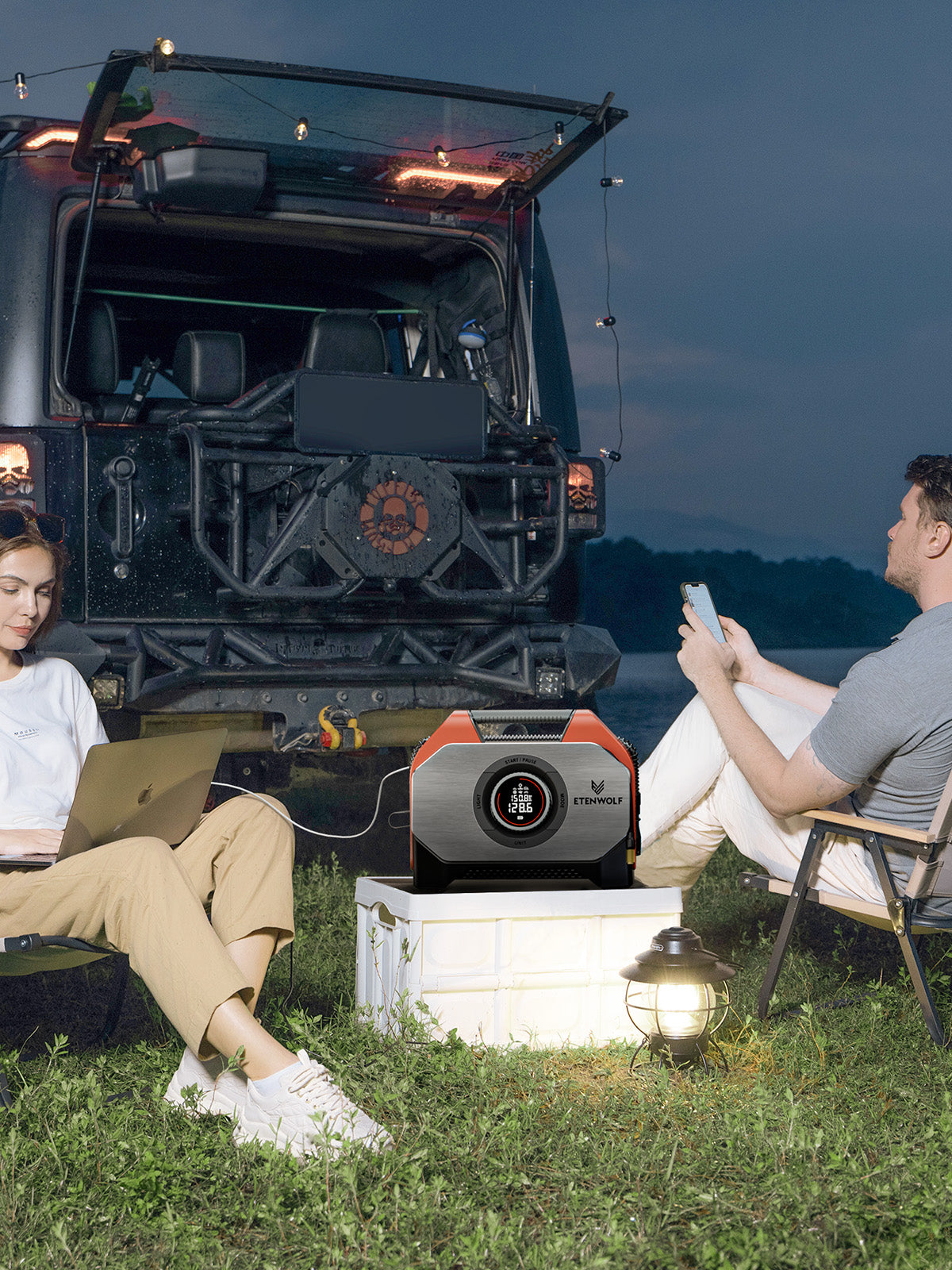
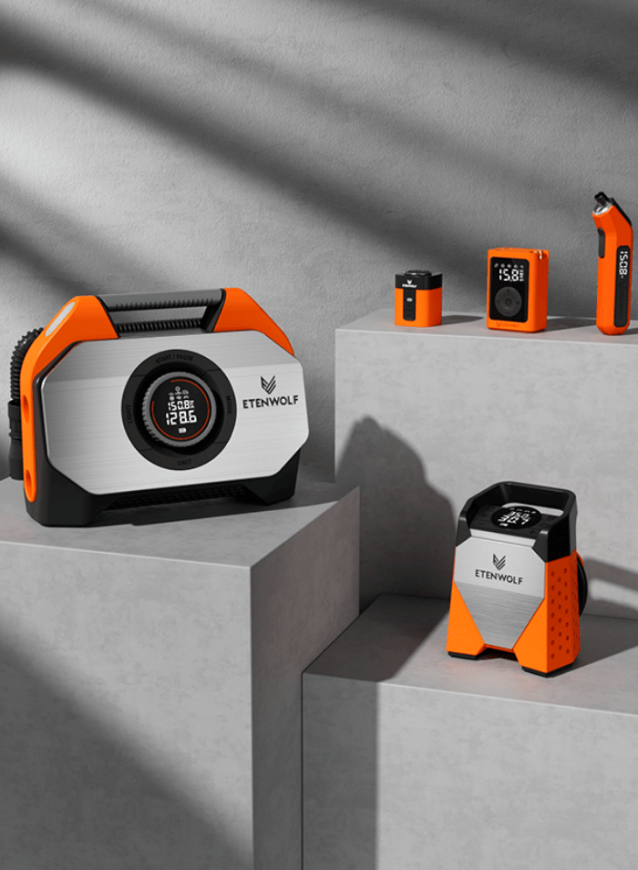
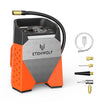
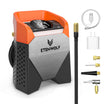
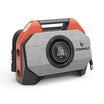
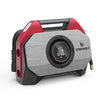
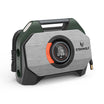
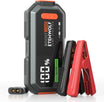
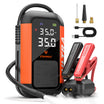
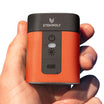
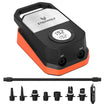
For pickups, trucks, large SUVs and other vehicles with high-volume tires, the ETENWOLF Vortex S7 Heavy Duty Tire Inflator is designed around that job.
Its dual 260W motors deliver 52 L/min (1.85 CFM at 0 PSI), giving it the airflow needed for large tires rather than just small emergency top-ups.
The built-in 38,400mAh battery also means you aren't dependent on finding a gas station or keeping the compressor tethered to the vehicle while you're adjusting pressure in a remote parking area or campsite.
For repeated adjustments, ETENWOLF rates the S7 for a 100% duty cycle, supported by its cooling system and dual-cylinder design.
And in a mountain-pressure scenario, one detail is especially useful: the S7's air chuck allows you to monitor pressure and release air when pressure genuinely needs to come down, then inflate again when pressure needs to come back up.
That makes the workflow much simpler:
measure → decide → release or inflate → recheck
Not:
altitude changed → start letting air out.
A tire inflator can't tell you what pressure your vehicle requires.
Your owner's manual and tire placard do that.
The S7 simply gives you the ability to make the adjustment when you're far from the equipment you would normally depend on.

Don't Confuse High-Altitude Travel With Off-Road Airing Down
There's another distinction worth making.
Off-road drivers sometimes deliberately reduce tire pressure for sand, rocks or certain low-speed trail conditions.
That's known as airing down.
It has a completely different purpose from adjusting tire pressure because of altitude or temperature.
If you're driving a pickup to a high-altitude trail and then airing down for off-road terrain, you're dealing with two separate pressure decisions:
Road pressure should follow the vehicle/tire requirements.
Off-road pressure depends on tire construction, load, terrain, wheel setup and vehicle use.
And when the trail ends, those tires need to return to safe road pressure before highway driving.
This is another reason the S7's combination of high airflow and air-release capability makes sense for heavy-duty adventure vehicles.
But don't mix the two concepts.
High elevation alone isn't a reason to run off-road tire pressures on pavement.
Final Thoughts: Let the Gauge Guide You, Not the Elevation Sign
High altitude doesn't automatically mean your tires need more air.
It doesn't automatically mean they need less air either.
The atmosphere becomes thinner as you climb, which tends to increase conventional gauge-pressure readings.
Mountain temperatures often fall at the same time, which tends to lower tire pressure.
Then driving heats the tires and pushes pressure upward again.
That's why looking at the elevation sign and guessing is a poor strategy.
The better routine is less dramatic:
Check your vehicle's recommended pressure before the trip.
Pay attention to TPMS warnings.
If you're staying at a much higher elevation, measure the tires cold the next morning.
Follow any altitude-specific instructions in your owner's manual.
If the tires are genuinely low, add air.
If the vehicle specification says pressure needs to come down, release it carefully.
And after returning home, check them again.
Mountain driving brings enough variables already.
Your tire pressure doesn't need to be another guessing game.
FAQs
Does tire pressure increase at high altitude?
A conventional gauge reading tends to increase as atmospheric pressure decreases with altitude, assuming temperature remains the same. Tire temperature and ambient temperature can change the real-world result, so altitude alone doesn't predict exactly what you'll see.
Why does tire pressure sometimes drop in the mountains?
Mountain destinations are often much colder than the place where the trip began. Tire pressure falls as temperature drops, by roughly 1 psi for every 10°F in common conditions.
Can high altitude turn on the TPMS light?
A mountain trip can coincide with a TPMS warning, but altitude should not automatically be blamed. Cold temperature, existing underinflation, a slow leak and vehicle-specific TPMS behavior can all contribute. If the warning appears, measure the tires rather than ignoring it.
Should I lower my tire pressure at high altitude?
Not simply because the gauge number increased. Check the pressure cold and follow your vehicle manufacturer's instructions. Some manufacturers even specify additional pressure at high altitude, which is why vehicle-specific guidance matters.
Should I inflate my tires before driving into the mountains?
Start with the manufacturer's recommended cold tire pressure unless your owner's manual specifies a different adjustment for altitude, load or driving conditions. NHTSA recommends using the driver's-door placard or owner's manual rather than the maximum PSI printed on the tire sidewall.
Why is tire pressure higher after driving in the mountains?
Driving heats the tires, and warmer tires normally show higher pressure. Don't reduce a hot tire to the manufacturer's cold-pressure number simply because the reading increased during the drive. Recheck when the tires are cold.
How long should I wait before checking cold tire pressure?
NHTSA defines cold tires for pressure checking as tires on a vehicle that has not been driven for at least three hours.
What if only one tire loses pressure at altitude?
Altitude and temperature generally affect all tires. One tire losing considerably more pressure than the others may indicate a puncture, valve problem or other leak and should be inspected.
Do I need to check the tires again after coming down from high altitude?
Yes, especially if you adjusted pressure while staying at elevation. Let the tires cool and recheck them after returning to your normal environment.
Is a portable tire inflator useful for mountain driving?
Yes, particularly when you're traveling far from service stations. An inflator can help correct genuinely low pressure, while a unit with controlled air-release capability can also help when pressure actually needs to be reduced. Always decide the target pressure from the vehicle manufacturer's guidance rather than altitude alone.


Leave a comment
All comments are moderated before being published.
This site is protected by hCaptcha and the hCaptcha Privacy Policy and Terms of Service apply.