


















Look through the wheel of most modern cars and you'll probably see a brake disc.
A shiny metal rotor. A caliper wrapped around one side. Maybe even a brightly painted performance caliper if the manufacturer wants you to notice it.
That makes it easy to assume drum brakes belong to another era.
Then you look at the specification sheet for a new compact car—or even an electric vehicle—and find something unexpected:
rear drum brakes.
That raises an obvious question.
If disc brakes are newer, easier to cool and widely used on performance vehicles, why haven't drum brakes disappeared?
The answer is more interesting than "because they're cheaper."
Disc and drum brakes solve the same basic problem in different ways, and each still has situations where its design makes sense.
To understand why, it helps to start with what actually happens when you press the brake pedal.
What Is a Disc Brake?

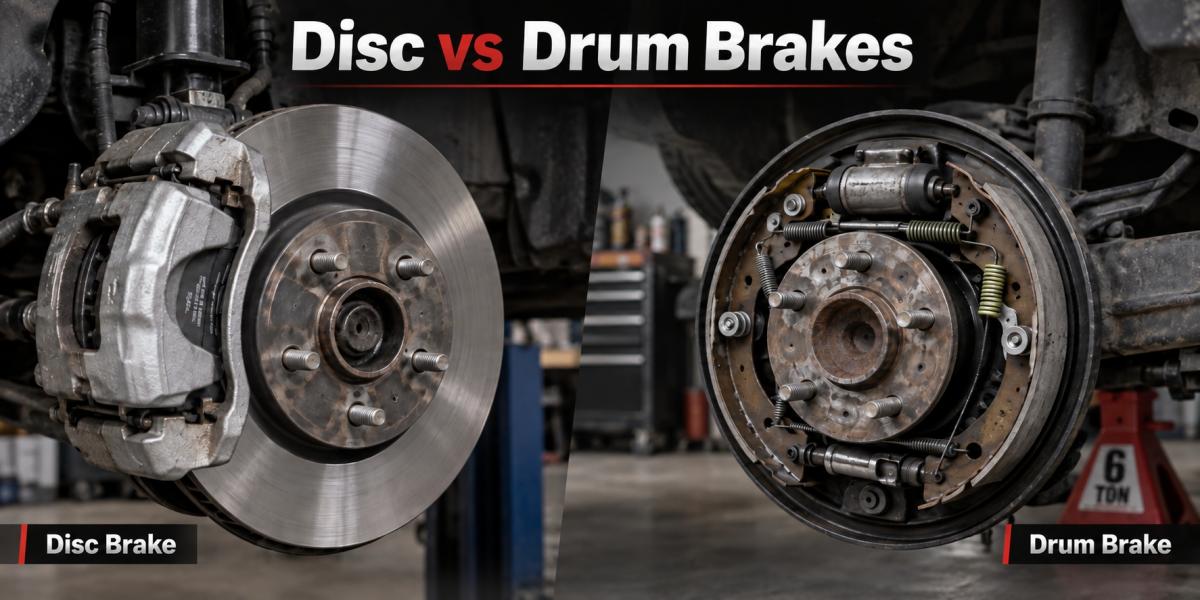
A disc brake uses three main parts:
· a brake rotor, or disc;
· brake pads;
· a brake caliper.
The rotor spins with the wheel.
When you press the brake pedal, hydraulic pressure moves the caliper pistons, pushing the brake pads against both sides of the rotor.
That friction converts the vehicle's kinetic energy into heat.
The harder and more frequently you brake, the more heat the system has to manage.
This is where disc brakes are particularly good.
Because the rotor is exposed to moving air, heat can escape relatively quickly. Ventilated brake rotors improve that cooling even further by allowing air to move through internal channels.
HELLA notes that ventilated brake discs have greater heat-storage capacity and cool faster than solid discs. It also explains that greater braking forces act on the front axle during braking because of dynamic axle-load transfer, which is why ventilated discs are commonly used at the front. (Source)
That explains why disc brakes dominate front axles on modern vehicles.
They spend a lot of time doing the hardest part of the job.
What Is a Drum Brake?

A drum brake works differently.
Instead of pads squeezing a rotating disc from the outside, the braking components sit inside a round brake drum attached to the wheel.
Inside are:
· brake shoes;
· a wheel cylinder;
· return springs;
· an adjustment mechanism.
When you press the brake pedal, hydraulic pressure moves the wheel cylinder.
The brake shoes expand outward and press against the inside surface of the rotating drum.
Friction slows the drum—and therefore the wheel.
When you release the brake, springs pull the shoes back away from the braking surface.
Bosch describes the same basic arrangement: the drum rotates with the wheel, the brake shoes press against its inner surface, and the wheel cylinder converts hydraulic pressure into mechanical force. (Source)
Mechanically, drum brakes are older.
That does not automatically make them obsolete.
Disc vs Drum Brakes: What's the Difference?
Here is the practical comparison most drivers actually care about:
| Feature | Disc Brakes | Drum Brakes |
|---|---|---|
| Heat dissipation | Better | More limited |
| Repeated hard braking | Better suited | More prone to heat buildup |
| Front axle use | Very common | Uncommon on modern passenger cars |
| Rear axle use | Common | Still widely used |
| Inspection | Easier to see | Drum usually must be removed |
| Manufacturing cost | Generally higher | Generally lower |
| Self-reinforcing effect | No | Yes |
| Parking-brake integration | Possible, sometimes more complex | Very convenient |
| Protection from dirt | More exposed | Enclosed design |
| Wear rate | Depends on use | Often relatively low |
| EV rear-brake use | Common | Increasingly attractive in some designs |
Neither column automatically means "good" or "bad."
It depends on where the brake is being used and what the vehicle needs it to do.
Why Are Front Brakes Usually Disc Brakes?
Brake hard and the nose of the vehicle dips.
That's weight transfer.
As the car decelerates, load shifts toward the front axle. The front tires can therefore handle more braking force than the rear tires before losing grip.
This means the front brakes usually do more work.
More braking work means more heat.
And heat is one of the main reasons disc brakes have such a strong advantage at the front.
This is also why the classic combination:
front disc + rear drum
has survived for so long.
Put the more heat-resistant system where the workload is highest.
Use the simpler system where braking demand is lower.
If Disc Brakes Are Better at Cooling, Why Are Drum Brakes Still Used?

This is the part that makes the comparison interesting.
Drum brakes still have several real advantages.
1. They Cost Less to Manufacture
This matters, especially on small and affordable vehicles.
A rear braking system does not always need the thermal capacity of a high-performance disc setup.
If a drum brake can provide the necessary braking performance safely at lower cost, manufacturers have little reason to add complexity just because discs look more modern.
2. They Have a Self-Reinforcing Effect
When the brake shoe contacts the rotating drum, the rotation of the drum can help pull the shoe more firmly into contact.
This is often called a self-servo or self-reinforcing effect.
In practical terms, the drum design can produce substantial braking force with relatively modest actuation effort.
3. They Can Wear Slowly
Rear brakes generally do less work than front brakes on many conventional vehicles.
Combine that with the operating characteristics of a drum brake and the shoes can last a long time.
That matters to drivers who care more about durability and cost than track-day heat management.
4. The Enclosed Design Has Advantages
A brake drum largely encloses its working components.
That helps protect the internal mechanism from road dirt and debris.
The same enclosed architecture is also becoming surprisingly useful in electric vehicles.
We'll get to that in a moment.
Why Do Some Electric Cars Use Drum Brakes?
This is where an "old" technology suddenly starts making modern sense.
Electric vehicles can slow down in two ways.
One is through conventional friction brakes.
The other is regenerative braking.
During regenerative braking, the electric motor works as a generator, converting part of the vehicle's kinetic energy back into electrical energy.
That means the friction brakes may be used less frequently during ordinary driving.
Volkswagen's ID.4 is a useful real-world example.

Volkswagen explains that on the ID.4, regenerative braking can handle much of normal everyday deceleration. The electric motor alone manages braking up to roughly 0.25 g before the hydraulic wheel brakes become more involved. (Source)
The ID.4 therefore uses large disc brakes at the front but drum brakes at the rear.
Volkswagen says the rear friction brakes are rarely needed in ordinary use because so much deceleration comes from the electric motor. The company also states that the enclosed rear drums avoid the corrosion concerns that can arise when conventional friction brakes spend long periods barely being used. (Source)
That's an important shift in perspective.
For decades, drum brakes survived partly because they were inexpensive.
In some EVs, they're now attractive for another reason:
The rear friction brakes may simply not need to work very often.
A high-performance open disc brake isn't automatically the best engineering choice for a component that spends much of its life waiting.
Are Drum Brakes Coming Back Because of EVs?
Not universally.
And this is where it's easy to overstate the trend.
Some EV manufacturers use rear drums.
Others continue using four-wheel discs.
The reason is that EV braking systems differ significantly depending on:
· vehicle weight;
· performance target;
· regenerative-braking strategy;
· rear-axle braking demand;
· packaging;
· cost;
· driving dynamics.
Even within the same manufacturer, different EV platforms can use different solutions.
So the right conclusion is not:
"EVs are bringing drum brakes back."
It's:
Regenerative braking has created new situations where the traditional disadvantages of rear drum brakes matter less and some of their advantages matter more.
That is a much more accurate way to describe what's happening.
Do Drum Brakes Get Loose?
Drivers sometimes describe older drum brakes as feeling "loose."
Mechanically, that isn't quite the right term.
Brake shoes gradually wear down.
As they wear, the clearance between the shoes and the inside of the drum can increase.
If that clearance became too large, the shoes would have to move farther before contacting the drum.
That could result in:
· increased pedal travel;
· weaker initial response;
· excessive parking-brake travel.
The solution is an adjusting mechanism.
Many modern drum-brake systems use an automatic adjuster designed to maintain the correct shoe-to-drum clearance as the friction material wears.
So normally, you should not have to keep manually "tightening" the rear drums.
But automatic does not mean indestructible.
An adjuster can:
· seize;
· corrode;
· become incorrectly installed;
· suffer mechanical damage.
HELLA has documented cases where failure of the automatic adjusting mechanism resulted in poor service-brake and parking-brake performance. (Source)
If a parking-brake lever suddenly requires much more travel than before, or rear braking performance appears weak, the system should be inspected rather than simply tightened blindly.
Are Disc Brakes Maintenance-Free?
Definitely not.
Disc brakes are easier to inspect, but that doesn't mean they look after themselves.
Wear items include:
· brake pads;
· rotors;
· caliper slide mechanisms;
· brake fluid;
· hoses;
· seals.
Brake discs also deal with serious heat.
HELLA notes that braking converts kinetic energy into thermal energy and that brake discs can reach extremely high temperatures under severe conditions. Ventilated discs are specifically designed to handle and release that heat more effectively. (Source)
That is one of the reasons discs remain the preferred solution for:
· repeated hard braking;
· heavy vehicles;
· performance driving;
· mountain descents;
· towing applications with high braking loads.
Drums remain useful.
Discs remain better at managing repeated heat.
Both things can be true.
Which Is Better: Disc or Drum Brakes?
If you ask:
Which is better for repeated high-performance braking?
Disc brakes.
Their ability to dissipate heat gives them a major advantage.
If you ask:
Which can be more economical for a lightly loaded rear axle?
Drum brakes can make excellent sense.
If you ask:
Which is better for an EV rear axle that rarely uses friction braking?
The answer depends on the vehicle, but drums can be a very logical solution.
If you ask:
Which is safer?
That's not a useful comparison by itself.
A properly engineered and properly maintained braking system matters far more than whether the rear axle happens to use drums or discs.
A well-designed front-disc/rear-drum system can be completely appropriate for the vehicle it was designed for.
The better brake isn't simply the newer-looking one.
It's the one correctly engineered for the job.
Your Brakes Don't Work Alone
This is where brake discussions often stop too early.
We talk about:
pads;
rotors;
drums;
calipers;
hydraulic pressure.
But all of that braking force still has to reach the road.
And there's only one vehicle component actually touching it:
the tire.
You can have excellent brake hardware and still compromise braking performance if the tires are in poor condition.

NHTSA explains that tire traction ratings reflect a tire's ability to stop on wet pavement and that higher-traction tires should allow shorter wet stopping distances than lower-rated ones.
Pressure matters too.
NHTSA's technical assessment of tire-pressure monitoring systems explains that underinflation changes both the tire's footprint and the pressure it applies to the road surface. That can reduce the tire's ability to transmit braking force, particularly on wet surfaces, and can increase stopping distance under some conditions. (Source)
So brake maintenance and tire maintenance are not separate safety conversations.
They're different parts of the same system.
Brake Maintenance Ends Where Tire Maintenance Begins
NHTSA recommends checking tire pressure at least once a month while the tires are cold, including the spare if the vehicle carries one. The correct PSI comes from the vehicle manufacturer's tire placard or owner's manual—not from the maximum pressure printed on the tire sidewall. (Source)
That matters even more on:
· pickups;
· trucks;
· large SUVs;
· off-road vehicles;
· vehicles carrying or towing heavy loads.
The larger the tire, the more air volume has to be moved when pressure is low.
And that's where the limitations of a tiny emergency pump become obvious.
Revisit related articles:
Why Most Tire Inflators Fail on Heavy-Duty Tires
Why Is My Steering Wheel Shaking?
Why Tire Pressure Changes after Inflation
Keeping Heavy-Duty Tires Ready for the Road

For a compact sedan, topping up a few PSI doesn't require much airflow.
A large pickup or truck tire is a different job.
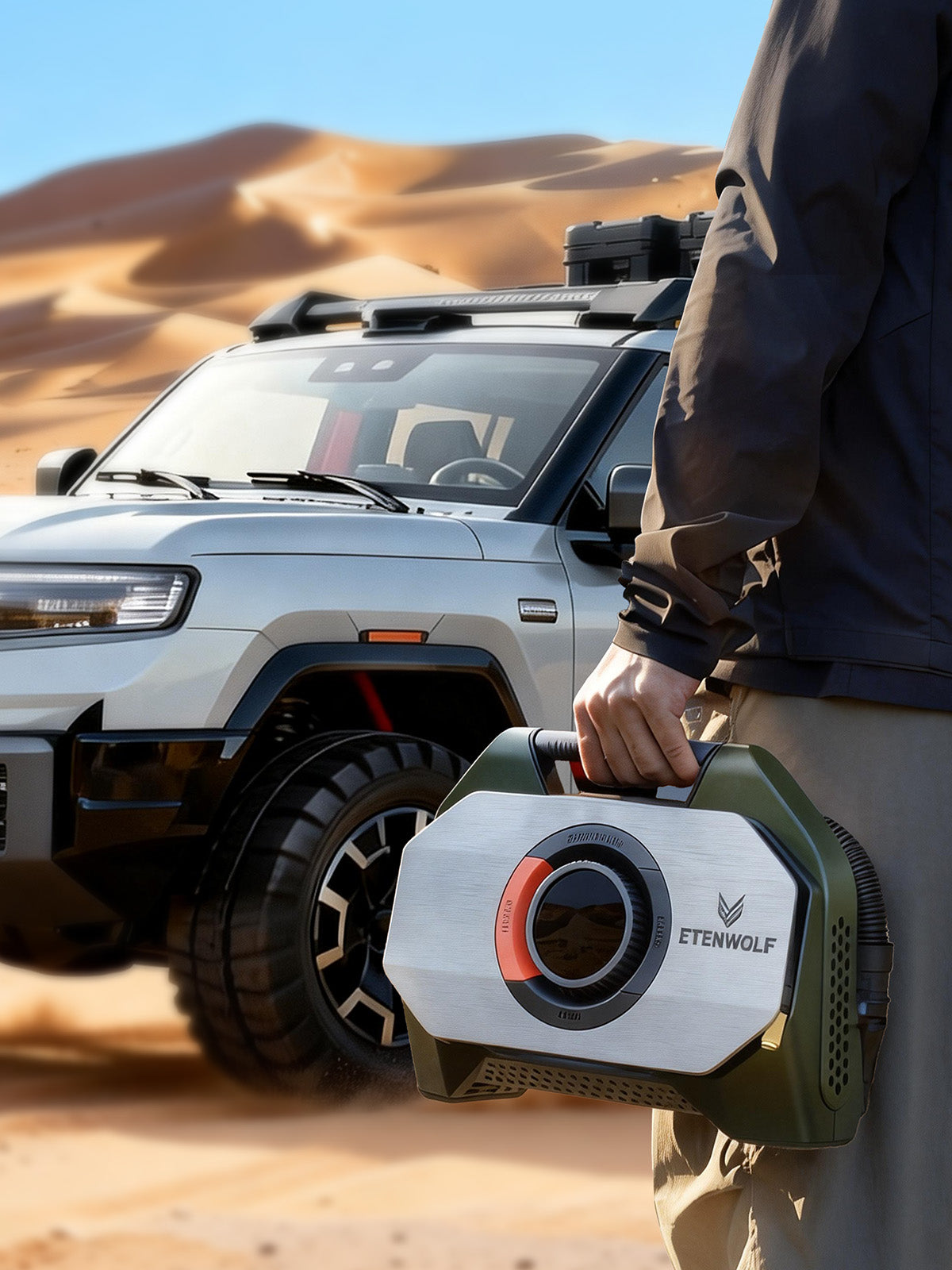
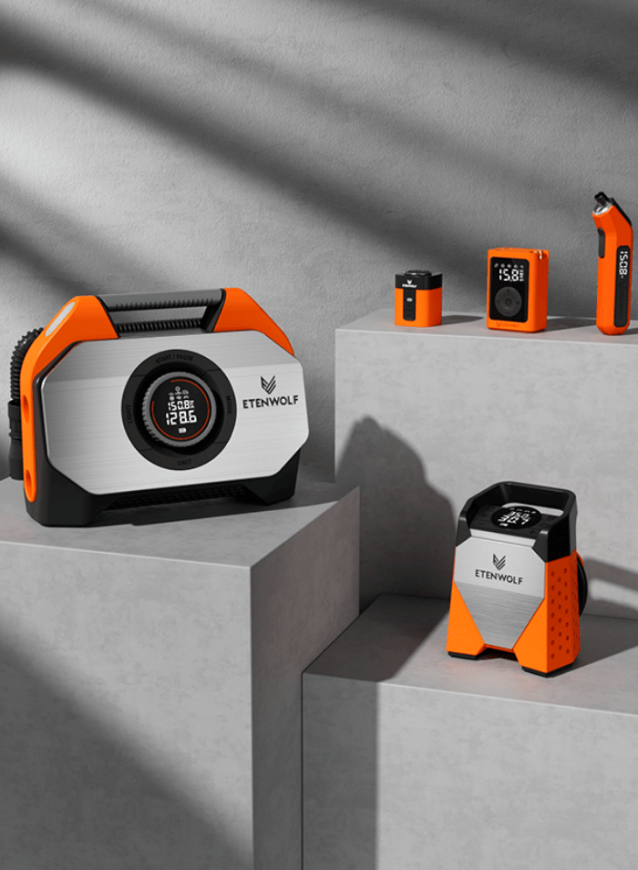
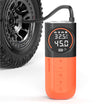
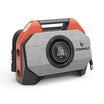
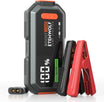
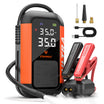
That's where the ETENWOLF Vortex S7 Heavy Duty Tire Inflator fits naturally into the maintenance side of this discussion.
The S7 uses dual 260W motors and delivers 52 L/min, or 1.85 CFM at 0 PSI, allowing it to move substantially more air than a typical compact emergency inflator.
Its 38,400mAh battery provides the capacity needed for repeated tire maintenance away from a wall outlet or gas-station compressor.
And for larger tires, one specification matters just as much as inflation speed:
duty cycle
ETENWOLF rates the S7 for a 100% duty cycle, supported by a dual-cylinder design and dedicated cooling system. That means it is built for continuous inflation instead of repeatedly stopping to cool when working on large-volume tires.
That makes it particularly well suited to:
· pickups;
· larger SUVs;
· trucks;
· RV applications;
· off-road vehicles.
But the role of the S7 should be clear.
A tire inflator does not improve the brake system.
It helps maintain the tires that the brake system depends on.
That's a much more useful connection than pretending a portable compressor is somehow part of the brakes themselves.

Final Thoughts: Good Brakes Still Depend on Good Tires
Disc brakes didn't make drum brakes obsolete.
They simply became the better solution for many braking jobs.
Discs dissipate heat well and handle repeated hard braking effectively, which is why they dominate front axles and performance applications.
Drum brakes trade some thermal performance for lower cost, low wear, compact packaging and an enclosed design that can still make excellent sense on rear axles.
Electric vehicles have made that old tradeoff interesting again.
When regenerative braking handles much of everyday deceleration, the rear friction brakes may operate far less frequently. In that environment, the durability and enclosed construction of a drum brake can become an advantage rather than a compromise.
And whether your vehicle uses:
four-wheel discs;
front discs and rear drums;
or regenerative braking combined with friction brakes;
the braking system still has one final job left after the pads or shoes create friction:
getting that force to the road.
That's the tire's job.
Maintain the brakes.
Maintain the tires.
Keep the correct pressure.
Because good brakes can only do their best work when the rest of the vehicle is ready to do its part.
FAQs
Are disc brakes better than drum brakes?
Disc brakes generally manage heat better and are better suited to repeated heavy braking. Drum brakes can offer lower cost, reduced wear and effective rear-axle braking. Which design is better depends on the vehicle and application.
Why do cars still use drum brakes?
Drum brakes remain useful because they can cost less to manufacture, have a self-reinforcing effect, wear relatively slowly and work well on rear axles where braking demand is often lower.
Why are drum brakes usually on the rear wheels?
During braking, vehicle load shifts toward the front axle, so the front brakes typically handle greater braking forces. Rear brakes often experience lower thermal loads, making drums a practical option on some vehicles.
Why do some EVs use rear drum brakes?
Regenerative braking can handle much of normal deceleration, meaning rear friction brakes may be used less frequently. Volkswagen's ID.4 is one example of an EV using rear drum brakes partly because regeneration performs much of the everyday braking work.
Do drum brakes need adjustment?
Many modern drum brakes use automatic adjustment mechanisms that compensate for brake-shoe wear. If the adjuster becomes damaged or stuck, excessive clearance and weaker braking performance can result.
Can drum brakes become loose?
The brake itself does not simply "loosen," but wear or failure of the adjustment mechanism can create excessive shoe-to-drum clearance. Parking-brake cables and related hardware can also require inspection or adjustment.
Are drum brakes safe?
Yes, when properly engineered and maintained. Drum brakes are still used in modern vehicles because they can meet the braking requirements of specific applications.
Can low tire pressure affect braking?
Yes. NHTSA explains that underinflation changes the tire's contact footprint and pressure distribution and can reduce its ability to transmit braking force, particularly on wet surfaces.
How often should tire pressure be checked?
NHTSA recommends checking all tires at least once a month while they're cold. Use the vehicle manufacturer's recommended pressure found on the doorjamb placard or in the owner's manual.



Leave a comment
All comments are moderated before being published.
This site is protected by hCaptcha and the hCaptcha Privacy Policy and Terms of Service apply.